
Smith County Released Inmate Meaning
A release from Smith County Jail means the jail ended its physical custody. It does not always mean the person entered the community. A person may post bond, receive release on recognizance, finish a local term, obtain a dismissal or other court order, start probation after split confinement, or transfer to another agency. The Smith County jail record identifies the local event. The court file explains the legal authority. If TDOC, another county, a federal authority, or ICE received the person, confinement may continue after the Smith County release.
That distinction controls every sound search. Smith County Jail and the Smith County Sheriff's Office keep local custody records. The originating court keeps bond, judgment, sentence, dismissal, and probation orders. The Tennessee Department of Correction, or TDOC, covers current and former Tennessee felony offenders in its FOIL system. VINE reports live custody status and sends notices. BOP and ICE cover only their own forms of federal custody. One system cannot answer for all the others.
Smith County Release Paths
Smith County released inmates leave local custody through several paths, and each path creates a different set of useful records. Bond and recognizance end jail custody while a case may stay open. Time served and sentence expiration depend on the judgment and sentence calculation. A dismissal, nolle prosequi, no true bill, or acquittal is a court outcome, though another charge or hold may still keep the person confined. A transfer ends Smith County custody but begins or continues custody elsewhere.
| Release path | What it means | Best next record |
|---|---|---|
| Bond or recognizance | Physical jail custody ends while the charge may remain pending. | Jail release entry and court bond order |
| Time served or sentence end | A local term ends after applicable credit and calculation. | Jail register and judgment |
| Dismissal or acquittal | A court resolves a charge without a conviction. | Final disposition or signed order |
| Probation after confinement | The jail portion ends and court-ordered supervision begins. | Sentencing order and supervision record |
| TDOC or agency transfer | Smith County custody ends, but confinement may continue. | Movement log and receiving-agency record |
| Medical move, death, or correction | A display may change without an ordinary release. | Available official custody-status record |
Parole is conditional release from a prison sentence into TDOC community supervision. Probation is court-ordered supervision that may follow local confinement or replace some confinement. Discharge means a custody or supervision obligation has ended. Time served means a court credits enough prior confinement to satisfy the ordered jail term. These terms are not interchangeable, so the recorded label and source matter.
Note: A transfer is a Smith County release event, but it should always name the agency that took custody next.
Smith County Release Record Fields
There is no single Smith County document called the universal release record. A complete trail may combine a jail-register entry, booking sheet, release authorization, movement log, bond order, judgment, or property receipt. Smith County has not published a field dictionary for its jail system. A request should ask for the fields below, but it should not assume that each field appears on one form or uses one fixed label.
| Requested field | What it can show |
|---|---|
| Full name, DOB, and booking number | Links the release event to the correct booking and helps separate namesakes. |
| Booking and release date or time | Places the start and end of Smith County custody on a timeline. |
| Release type or disposition | May identify bond, time served, court order, probation, or transfer. |
| Charges and bond | Ties the booking to the case and any bond authority. |
| Receiving agency | Shows whether custody continued with TDOC, another county, ICE, or another authority. |
| Booking photograph | Supports identity, but does not prove guilt, release, or case outcome. |
The originating court adds the legal result. Its file may contain the case number, charge, bond order, dismissal, plea or verdict, sentence, time-served credit, split confinement, probation, revocation, or expungement order. A calendar entry shows that a matter was set for court. It is not a judgment. For proof of why Smith County custody ended, pair the jail event with the signed order or final disposition.
Note: Ask for existing records by name and date range; an agency does not have to create a new narrative or perform open-ended research.
Request Smith County Release Records
Smith County publishes an Open Records Request link through its official county site. For jail material, direct the request to the Smith County Sheriff's Office or jail records custodian at 322 Justice Drive, Carthage, TN 37030. Call 615-735-2626 first to confirm the current records coordinator and submission route. Tennessee has no single public-record repository, so a court request and a jail request may both be needed.
- Identify the person by full name, date of birth if known, approximate booking dates, and booking or case number when available.
- Name the existing series: jail-register entry, booking sheet, release authorization, movement or transfer entry, and identification photograph.
- Ask for the recorded release date and time, release type, and receiving agency. Request electronic copies and a cost estimate before duplication.
- Use inspection when the set may be large. Select only the pages needed after reviewing what the custodian holds.
- If material is denied or redacted, ask for the written legal basis and any segregable public part.
Under Tenn. Code Ann. § 10-7-503, Tennessee citizens generally may inspect public records subject to exceptions, and a custodian may require identification with an address. If prompt production is not practical, the agency has seven business days to produce the record, issue a written denial with its basis, or provide a written explanation and reasonable production estimate. That is a response framework, not a promise that every request will be complete in seven days.
The state reasonable-charge schedule generally sets standard copies at $0.15 per black-and-white page and $0.50 per color page, unless actual cost is higher. Labor may be charged after the first hour. Inspection is ordinarily free unless another law permits a fee. Ask for an estimate because the statewide schedule does not guarantee the final cost of a Smith County request.
The Smith County Circuit Court Clerk page gives the route for court records. The clerk is at 322 Justice Drive, Suite 115, Carthage, TN 37030, and can be reached at 615-735-0500, Monday through Friday from 8 a.m. to 4 p.m. Ask separately for the judgment, dismissal, bond order, sentencing order, time-served entry, probation order, or other document that explains the custody decision.
The county's official page shows where an open-record request begins:

The image anchors the request to Tennessee's Smith County government, which helps avoid the unrelated Texas sheriff pages that dominate some searches.
Smith County Release Property Receipts
A permanent property-return receipt can provide unusually concrete support for the physical handoff at a Smith County release. Tennessee's sheriff retention schedule describes a receipt that itemizes property, valuables, and cash returned to the person. It also calls for the inmate's signature and the releasing officer's witness. Where the record is open after lawful redaction, those details may corroborate that property changed hands as local custody ended.
The receipt should not stand alone when the legal reason for release is disputed. It does not replace a bond order, judgment, or transfer entry. Still, it may help resolve a narrow date or handoff question when another jail document is brief. Request it by booking and approximate release date, then compare its date and signatures with the permanent jail register and any movement record.
The CTAS sheriff records schedule displays the retention rules used to identify these record series:
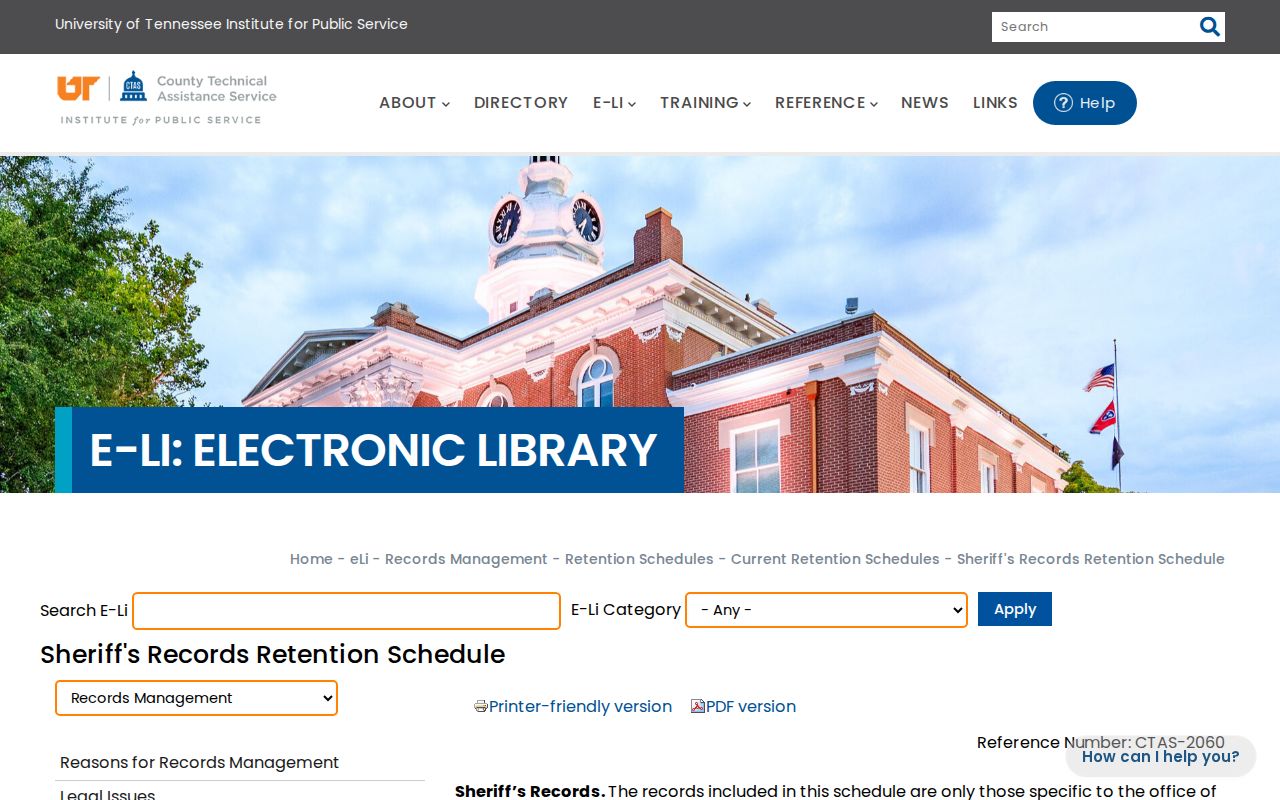
The schedule makes clear why a vanished web result and a destroyed underlying record are not the same thing.
Smith County Court Release Proof
Smith County's General Sessions page links to dated dockets in a Google Drive folder instead of offering a conventional searchable case database. The docket can help locate the right court date. It cannot confirm the final outcome. General Sessions handles misdemeanor criminal matters and felony preliminary proceedings, while Circuit or Criminal Court holds the later felony trial-level record.
Use the official General Sessions Court page to understand the local court route. Criminal court is ordinarily held Thursdays, except fifth Thursdays, at 9 a.m., though schedules may change. Once the date or case number is known, request the actual judgment, dismissal, bond order, sentence, or other custody-related order from the clerk. Smith County is part of Tennessee's five-county 15th Judicial District.
The officially linked Smith County docket folder shows the schedule-navigation format:
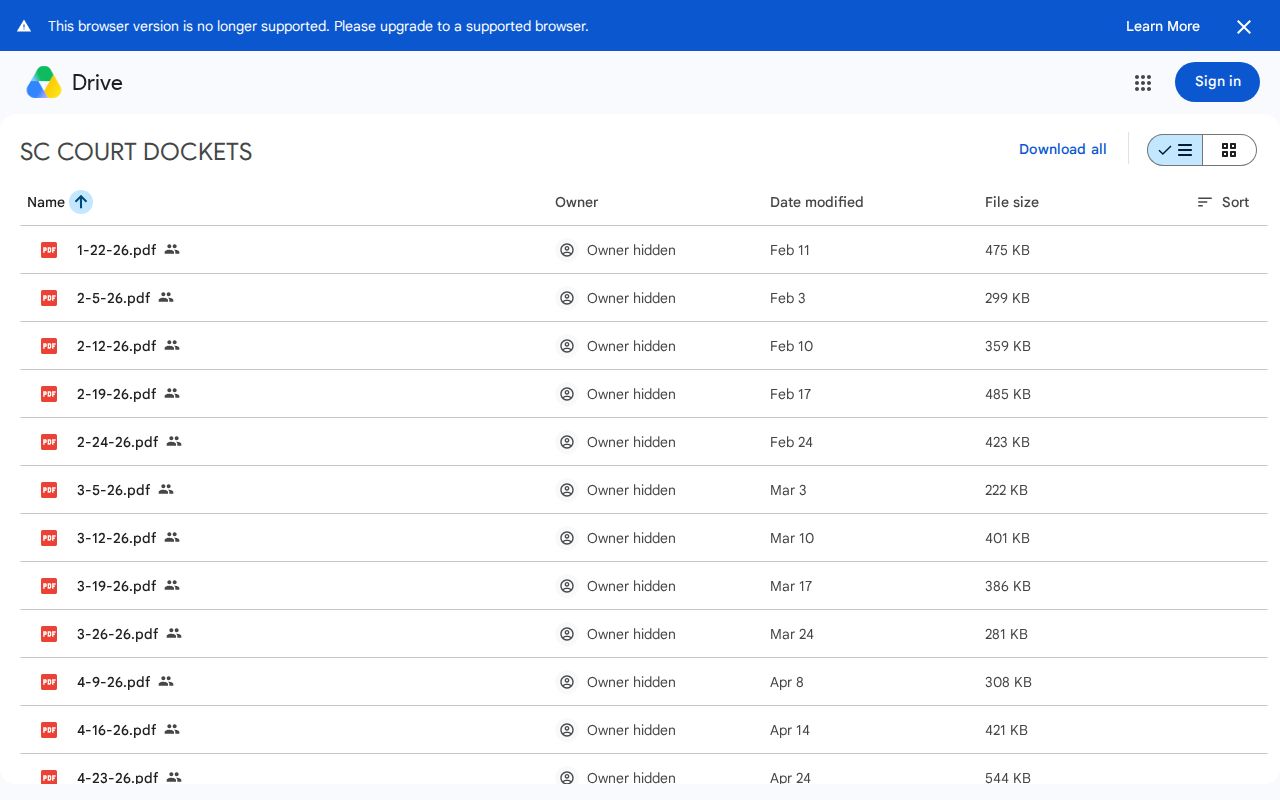
The date list is a starting point. The clerk's copy of the order is the stronger proof of why custody ended.
Note: A docket date may show a pending hearing after bond release, but it does not certify the hour a person left jail.
Smith County Release Expungement
Release and expungement are separate events. Tennessee court guidance lists several results that may qualify for free expungement, including dismissal, no true bill, not guilty, nolle prosequi, and arrest followed by release without charge. The request begins in the court where the case arose under Tenn. Code Ann. § 40-32-101. A person should obtain docket information, file the proper form, and retain certified copies of the expungement order and charging document.
Completing a jail term does not erase a Smith County court or release record. Conviction eligibility is narrower and can change with the statute. If a matter has been expunged or sealed, public results may disappear. Do not try to reconstruct or republish those facts from an old copy. Juvenile files and confidential information also follow separate rules. The record custodian determines what may be released after applying the current law.
Note: Keep the certified expungement order because an old index or copied record may not vanish from every system at once.
Smith County Release Statistics Context
TDOC publishes monthly jail summary reports from information submitted by each sheriff or jail administrator. Statewide statistical materials also include Smith County Jail. These sources can support a dated population snapshot or show broad jail trends. They are not names-based release lists, and a monthly count cannot prove that one person left Smith County custody on a given day.
Use the TDOC jail summary reports only for the period and measure stated in a report. Do not turn an average daily population, admission count, or month-end figure into an estimate of individual releases. A name, booking number, custody-ending time, and release type must come from the jail record. The court file then supplies the related legal action.
Find Smith County Released Inmates
No official Smith County, Tennessee, 24-hour or 72-hour release feed was found during the research sweep. No verified county web roster exposed release dates, reasons, archive rules, or booking photos. The prominent Smith County sheriff website and mobile app found in many search results belong to Texas. Confirm Carthage, Tennessee, the 615 area code, and Justice Drive before trusting a source.
- Call Smith County Jail at 615-735-2626. Ask if the person remains physically confined and, if not, when custody ended, the recorded type, and any receiving agency.
- Request the jail register, booking and release entries, release authorization, and movement or transfer record for exact local proof.
- Use the court docket to find the case, then obtain the final order or judgment from the clerk.
- Search TDOC FOIL when a felony sentence, state transfer, parole, or felony probation relationship exists.
- Use VINE for a live custody check or future alert, then confirm the event with the reporting agency.
- Search BOP or ICE only when the case record, movement log, or known identifier supports that route.
A county misdemeanor booking may never appear in FOIL. An old VINE event may age out. A BOP label answers only federal Bureau of Prisons custody, and an ICE result answers only immigration detention. When a search returns nothing, go back to the agency that owned the specific event. The same official fallback applies to Smith County same-day release checks.
Why is a released person absent from the jail list? A current-custody list is built to show who is held now. After the jail closes a booking or transfers the person, use the retained jail register, movement entry, and court order instead of treating the missing name as proof of community release.
Smith County FOIL Release Search
TDOC's Felony Offender Information system, called FOIL, covers Tennessee felony offenders who are now or were formerly in state custody or under TDOC supervision. Search the official FOIL form by name, TDOC ID, or State ID Number. Name search accepts last and first name, an optional alias search, and race, with a CAPTCHA. Compare date of birth, identifiers, aliases, descriptors, and any photograph when several people share a name.
| FOIL field | How to read it after release |
|---|---|
| Supervision Status | May show incarcerated, probation, parole, or inactive status. |
| Assigned Location | Names the recorded institution or supervision location. |
| Sentence Begin and End | Frames the state sentence but may change as records arrive. |
| Release Eligibility Date | The earliest possible parole eligibility point, not a promised exit date. |
| Parole Hearing Date or Result | Shows consideration or a decision, not by itself a completed physical release. |
| Active sentence rows | Reveal whether another Tennessee sentence remains recorded. |
Read these fields together. An inactive status or no active Tennessee sentences supports a former TDOC status, but it does not prove the exact moment a person left Smith County Jail. FOIL warns that information may not be accurate, timely, or complete. MyTN offers the same FOIL function as a valid state mobile option, but it is not a local Smith County release app.
The official TDOC FOIL page explains its current and former felony-offender scope:
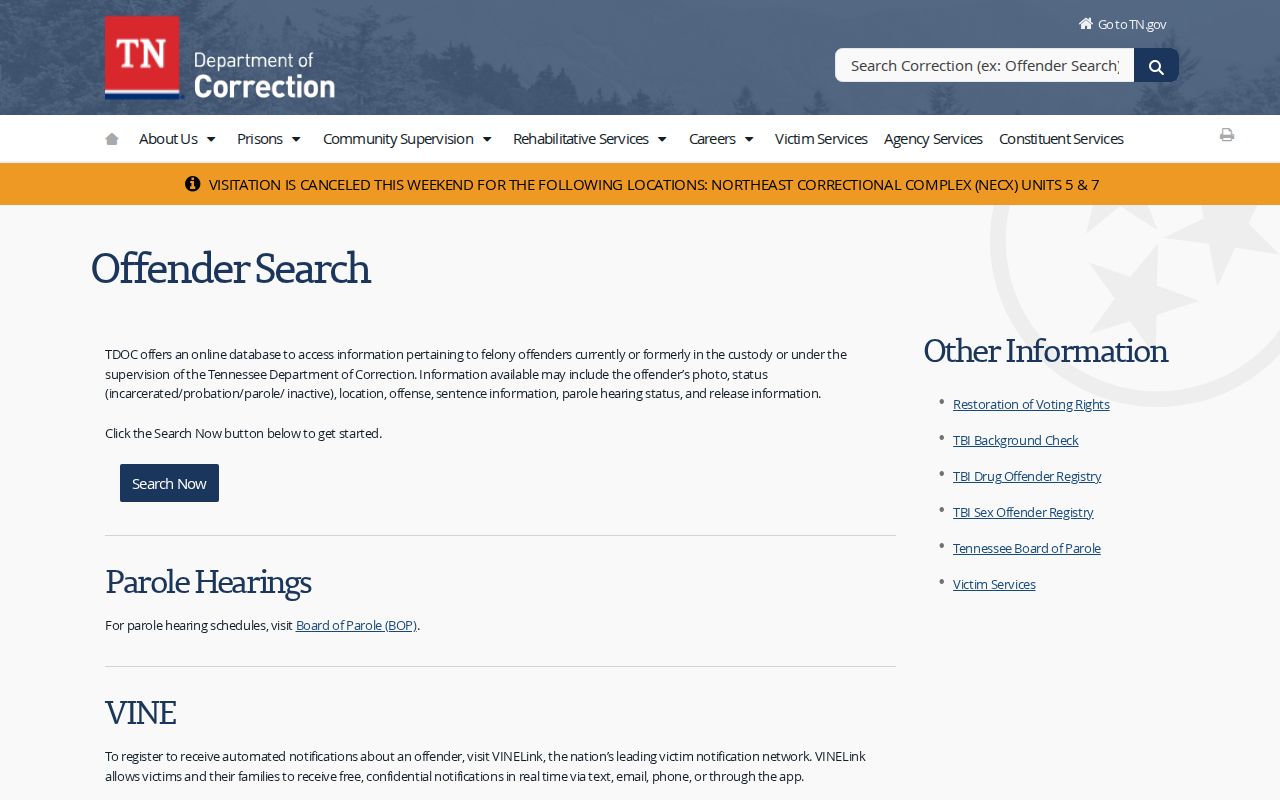
The state scope is broader than one jail, yet it still excludes many short county-only bookings.
FOIL is the fast public check, not the only state route. For older TDOC material, use the TDOC archived record request. Include the full offender name, TOMIS or TDOC number, date of birth, and a clear description of the record. TDOC says archive charges may apply and instructs requesters not to send payment until a charge notice arrives. Records Management answers questions at 615-253-8079.
Note: FOIL calls the forward-looking field Release Eligibility Date; it is neither a guaranteed release date nor proof of community entry.
Smith County Recent Release Limits
The absence of an official recent-release feed is an access limit, not evidence that Smith County keeps no release record. A same-day check begins by calling the jail. Ask a narrow question about current physical custody, then seek the recorded end time, release type, and receiving agency. For a three-day period, request the relevant entries for that date range instead of relying on a current screen.
Historical checks should start with retained records. Tennessee's schedule treats the Jail/Inmate Register as permanent. It lists the name, offense, committing authority or process, commitment date, and release date, sometimes with descriptors. Movement and booking logs, nonjudicial release orders, and judgment or sentence statements have five-year retention periods. Identification files, including photographs and fingerprints, last until death or presumed death at 100 years. Retention does not remove lawful limits or redactions, but it helps a requester name the right record.
Note: Date the search and request because a live status can change even while the retained Smith County release record remains available.
Smith County Release Supervision
Smith County has two distinct supervision routes. Local Recovery Court and misdemeanor probation operate at the Justice Drive complex. The county describes case-manager and probation contact with biweekly or monthly reporting depending on the case. TDOC District 31 in Cookeville serves felony parole and probation. Sending a state parolee to the local misdemeanor office would route the inquiry to the wrong agency.
The Smith County Recovery Court and Probation page is the local source. For a felony case, FOIL may show probation or parole as the supervision status, while the TDOC field-office directory identifies District 31. Parole means release from prison under Board conditions before sentence expiration. Probation comes from the court and can follow split confinement. A supervision record does not replace the jail record that marks physical release.
- Parole
- Conditional community supervision after release from prison, based on a Board decision.
- Probation
- Court-ordered community supervision that may follow or replace part of confinement.
- Split confinement
- A sentence with a jail portion followed by probation.
- Discharge
- The formal end of a custody or supervision obligation.
For more on which office owns a case, use the Smith County parole and probation lookup.
Smith County ICE Transfer Releases
An ICE detainer changes what a Smith County release can mean. ICE describes a detainer as a request that the jail provide notice before ordinary release and keep custody for up to 48 hours beyond that point so the Department of Homeland Security may assume custody. A Smith County entry can therefore record release to ICE while the person remains confined.
Check the county movement record first. If it names ICE as the recipient, use the ICE Online Detainee Locator by nine-digit A-number and country of birth, or by exact first and last name, country of birth, and optional date of birth. ICE says its locator includes current detainees and people released from ICE custody during a limited 60-day period. A later ICE release is a second event and should not be merged with the earlier Smith County transfer.
The official ICE detainer explanation illustrates why transfer and community release must be kept apart:
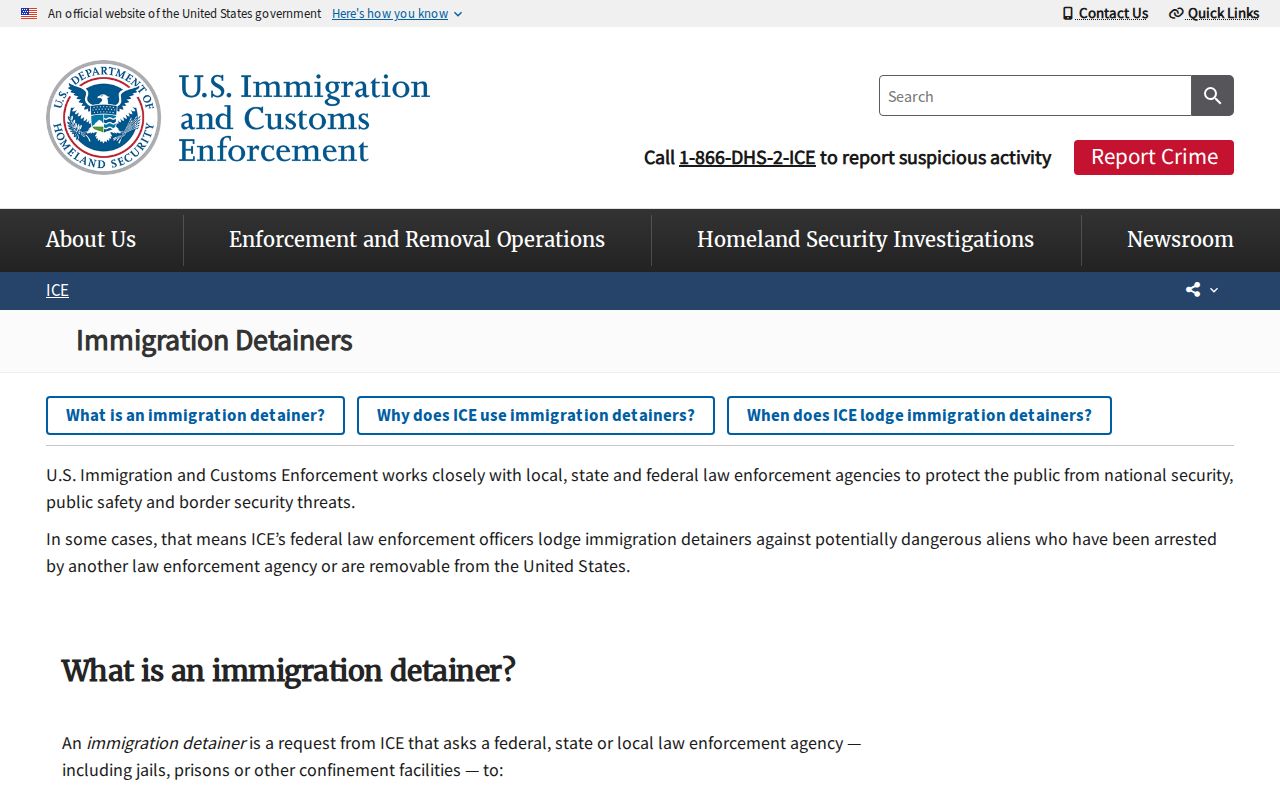
The jail's receiving-agency field is the key bridge between the county event and the federal search.
Smith County Release Status Compared
Choose a source by custodian and time frame. Current status tools are strongest for a live event. Retained jail and court files are stronger for an old Smith County release. A locator result should be quoted with the agency's own status and the date it was checked. Do not turn “not in this agency's custody” into the broader claim that a person is free.
Still in Smith County custody
Confirm directly with Smith County Jail. A live custody answer does not explain the future release date or court outcome.
Released from Smith County
Use the jail register, release authorization, and court order. Ask if another agency received the person.
TDOC custody or supervision
Use FOIL for a Tennessee felony relationship. Read status, location, sentences, and eligibility fields together.
Federal or immigration custody
Use BOP or ICE only when supported by the case or transfer record. USMS has no comparable public release archive.
VINE fits between these routes. Search Tennessee by name or offender ID, confirm the reporting agency and facility, and register while the record is still active. Alerts may arrive by phone, text, email, TTY, or app. A phone registration uses a private four-digit PIN to confirm the call. VINE supports current status and custody-event notice, but it is not a certified historical discharge archive.
For a supported federal case, the BOP Inmate Locator searches federal records from 1982 forward by register number or name. Its result can show a release date and “Released” or “Not in BOP Custody.” Those labels end the BOP part of the inquiry only. Another jail, state case, or supervision term may remain. USMS has no comparable public historical locator, so federal pretrial release must be checked through the federal docket, counsel, or the actual detention facility.
The TBI Sex Offender Registry is narrower still. It applies only when a statutory registration duty exists and is never a general Smith County released inmate list. Its absence says nothing broad about a person's custody history.
Smith County Release Facility
Smith County Jail is the only detention facility supported by the county research for a dedicated page. The Smith County Sheriff's Office operates it at 322 Justice Drive, Carthage, TN 37030, with the main number 615-735-2626. It holds people awaiting local court action, people serving local sentences, and felony defendants who may later transfer to TDOC.
Smith County Jail release records can show whether a person returned to the community or moved to TDOC, another county, federal custody, or immigration custody. No state prison, BOP institution, or dedicated ICE detention center was identified within Smith County. Nearby Trousdale Turner Correctional Center is in Trousdale County and should not be treated as a local facility.
Carthage, Gordonsville, and South Carthage police may make arrests, but no separate searchable municipal jail was verified. The arresting office and releasing custodian can differ. Start with the facility that physically held the person, then follow the court order and receiving agency recorded in that facility's files.