
Smith County VINELink Release Coverage
VINE means Victim Information and Notification Everyday. Tennessee’s county-jail layer is also described as SAVIN. The service carries live custody information and opt-in notices from participating agencies. TDOC joined VINE in 2021, while many county jails were already participating. That history created separate county and state feeds under one search service.
A Smith County result must name its reporting agency. A jail-fed status concerns custody reported by that jail. A TDOC status concerns Tennessee felony custody or supervision. A transfer from Smith County Jail to TDOC can trigger a county custody change while confinement continues in the state system. A displayed release status confirms only what the named agency reported.
VINE does not replace the permanent Smith County jail register, the court judgment, or a TDOC archive request. Its strength is timely notice. Records can change or age out, and a missing result is not proof that a past booking never occurred.
Search Smith County VINELink Records
Use the official VINELink search for one person. Start with identifiers, not assumptions about the event. A common name may return several records, and the same person can have records from more than one reporting agency. Compare only the facts the service provides.
- Open VINELink and choose Tennessee as the state.
- Enter the person’s full name or available offender ID. Try known spelling variants when a careful first search returns no match.
- Review the result list and compare identifiers before opening a record. Do not rely on name alone.
- Open the matching record and note the reporting agency, facility or location, custody status, and time of the displayed event.
- If the person appears under Smith County and TDOC, treat the records as separate custody layers and build the sequence by date.
- Save the exact event wording, then verify the event with the agency that supplied it.
No match has several possible causes. The name or identifier may differ, a feed may lag, the agency may not participate, or an older record may no longer display. For a county-only historical event, use the Smith County jail register and court file. For a felony relationship, check FOIL. The Smith County released-person lookup shows that broader evidence path.
The manifest capture shows the official Tennessee selection and search screen used to begin a Smith County VINELink release check.
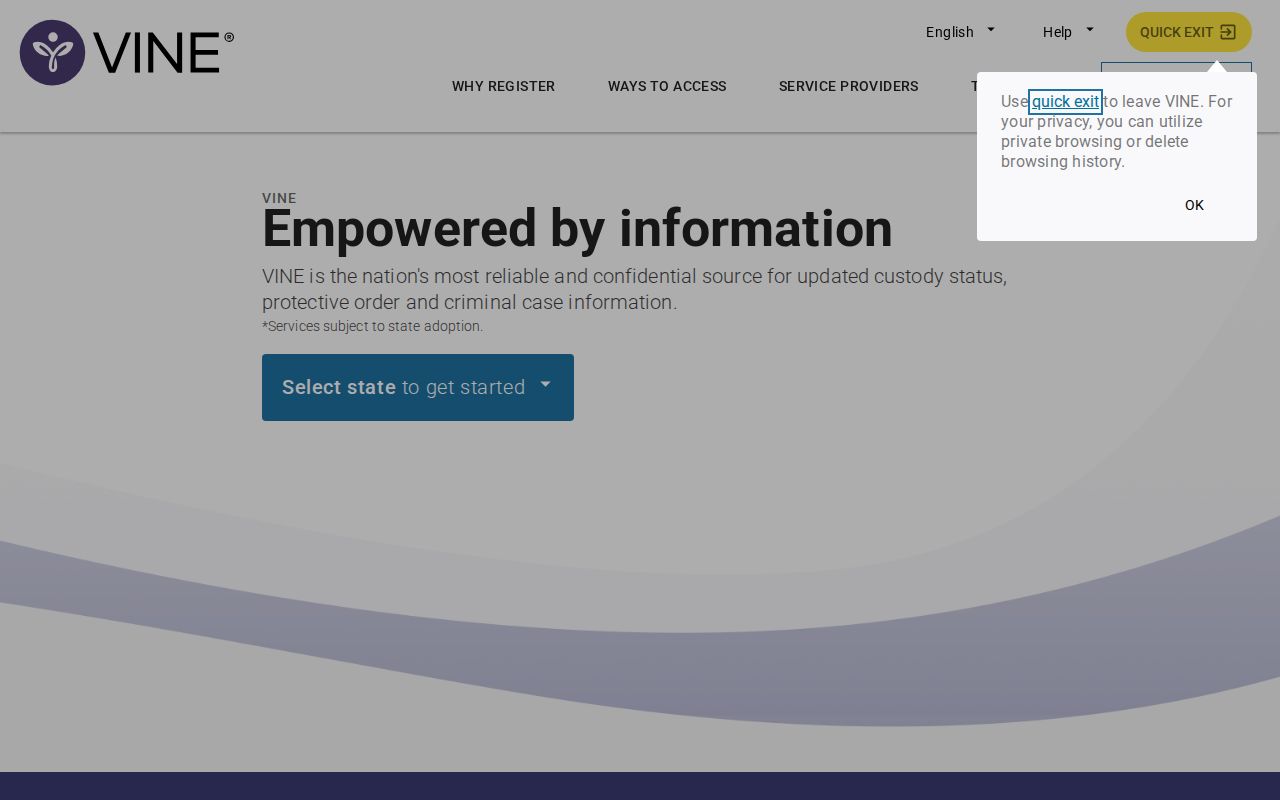
The state selection matters because polished Smith County, Texas results are unrelated to Smith County, Tennessee.
Smith County VINELink Release Fields
VINELink fields are meant to identify a person and state the reporting agency’s current custody information. Availability depends on the supplied record. The field set should not be expanded with details that are not shown, and no date should be relabeled as a certified court disposition.
| Field | How to read it |
|---|---|
| Name or offender ID | Search and identity keys used to distinguish the intended person. |
| Custody status | The status supplied by the named agency, such as in custody or a recorded release state. |
| Agency or facility | The jail or corrections source whose custody is being described. |
| Location | The reported custody site or agency location when provided. |
| Notification options | The contact methods and event types currently offered for that record. |
A released state does not answer whether another county, TDOC, ICE, or a federal agency took custody next. Ask Smith County Jail for the release or movement entry when the county event is disputed. The court order then explains the legal basis, such as bond, time served, dismissal, sentence, or transfer.
Note: A VINE event is a status notice from one reporting agency, not a permanent certified discharge record for every custodian.
Register Smith County Release Alerts
Register while the record remains active. Available delivery choices may include phone, text, email, TTY, or app delivery. The exact events offered appear during registration and can depend on the record. Choose only methods that can be kept current and private.
- Open the matched record and select Get Notified.
- Choose the event types shown for that record, such as a release, transfer, or custody change.
- Select an available phone, text, email, TTY, or app delivery method.
- Enter the contact information and complete the confirmation requested by VINELink.
- For telephone alerts, create a private four-digit PIN. Enter it when an automated call arrives to acknowledge the notice and stop repeat calls.
- Keep the event wording and time, then contact the reporting agency to confirm what changed.
Email alerts do not use the telephone PIN. The PIN should not be shared. Tennessee VINE support is available around the clock at 888-868-4631, and TDOC publishes victim.notification@tn.gov for its written victim-notification questions.
Registration does not create a court or jail record. It instructs the service to send an alert when the reporting feed records an offered event. If contact details change, update the registration while the record can still be found.
Why Smith County VINE Has Layers
TDOC’s 2021 entry into VINE is a useful local clue. County-jail feeds and state correctional data did not become one legal custody record. They remain agency-specific layers displayed through a common service. A Smith County Jail alert can mark the end of county custody. A later TDOC record can show that the person was received by the state, remained incarcerated, or moved onto felony supervision.
The TDOC VINE announcement describes the state corrections layer. For a reliable timeline, register while the relevant record is active, note which agency sent each alert, and request the underlying county movement or TDOC record when the difference matters.
This layered structure prevents a common mistake. “Released by Smith County” may mean released to another custodian. “Released by TDOC” may still leave a person on community supervision. Neither statement alone proves that every hold, sentence, or court duty ended.
Note: Registering in one agency layer does not establish that a separate Smith County or TDOC record is also covered.
Confirm Smith County Release Notices
After an alert, write down its time, status text, reporting agency, and facility. Call Smith County Jail at 615-735-2626 when the notice is county-supplied. Ask whether the person left Smith County custody for the community or was transferred to another custodian. For documentary proof, request the jail register entry, release authorization, or movement record rather than relying only on a phone statement.
When TDOC supplied the event, compare FOIL’s Supervision Status, Assigned Location, active sentences, Sentence End Date, and Release Eligibility Date. Release Eligibility Date is the earliest parole-eligibility point under the applicable sentence rules, not proof of actual release. Contact TDOC or request archived material when a past event is no longer clear online.
The originating Smith County court file explains why local custody ended. A docket date helps find the case, but the signed judgment, bond order, dismissal, probation order, or other disposition supplies the legal result. That record can outlast a temporary VINELink display.
Smith County Release System Boundaries
VINELink is not the federal Bureau of Prisons locator. It also is not the ICE Online Detainee Locator. A federal case or documented federal transfer belongs in the BOP system or the federal court record. An ICE transfer belongs in the ICE system. A Smith County person can move through more than one of these systems, with a distinct event date in each.
FOIL is the better public route for current or former Tennessee felony offenders. It is not a complete list of short Smith County bookings. The Smith County jail record remains the local source for a county custody-ending event. The permanent jail register can preserve a release date after an online status disappears.
The TBI Sex Offender Registry is narrower still. It applies only when a statutory registration duty exists. The official TBI registry may show an agency-supplied profile, but it is neither a general release search nor proof of a Smith County Jail event. Use each system only for its stated scope.
Note: A negative VINELink search can reflect spelling, timing, participation, or record aging and does not disprove prior Smith County custody.
Preserve Smith County Release Proof
A notification is most useful when paired with the record that caused it. Ask Smith County for the existing jail-register entry, release or transfer entry, and related movement record. Give a full name, date of birth when known, booking number, and a narrow date range. Ask for existing records, not a new narrative.
If the event involved TDOC, save the FOIL status and ask Records Management for historical state-offender material when needed. If it involved a court order, obtain the order from the Smith County Circuit Court Clerk. These records answer different questions: VINE tells when a feed changed, the custodian records where the person went, and the court file explains the legal basis.
A focused Smith County request should identify the person, booking period, and record series. Ask for the existing jail-register entry, booking sheet, release authorization, and movement or transfer entry. The permanent register can show the recorded release date after a live service no longer returns the person. Movement records may identify a receiving agency when county custody ended through transfer. If the jail entry uses a broad label such as court order, obtain that order from the clerk to determine whether the event involved bond, dismissal, time served, probation, or another result. This record pairing gives the alert both a physical-custody meaning and a legal basis.
Preserve the search date and exact agency wording. Live systems change. A later missing result should not be used to rewrite a documented earlier event, and an old alert should not be presented as current custody status without a fresh check.