
Smith County Release Date Meaning
A date is meaningful only when its label and agency are clear. For a Smith County pretrial detainee, there may be no set exit date. Bond can be posted, the court can change conditions, a charge can be dismissed, or another agency can take custody. The jail register records when county custody ended, while the court order explains why. Neither event should be predicted from a hearing date alone.
A sentenced inmate has a defined judgment, but several dates may appear. Sentence End Date concerns the computed end of a state sentence. Release Eligibility Date is the earliest point at which a qualifying felony inmate may become eligible for parole. An actual release date records the event that occurred. Eligibility is not a promise, and physical release can still be blocked by another sentence, a detainer, or an unapproved release plan.
A person can also leave Smith County Jail through transfer. If TDOC, another county, a federal authority, or ICE receives the person, Smith County custody ended but confinement did not. Every stated release date should name the custodian from which release is claimed.
Find Smith County Inmate Release Dates
Start by deciding whether the person is awaiting local court action, serving a local term, serving a Tennessee felony sentence, or held under federal authority. The source changes with that answer. A current jail display, if one exists, is for people still shown in custody and cannot serve as a historical released-person record.
- Call Smith County Jail at 615-735-2626 and ask whether the person remains physically confined.
- If county custody ended, ask for the recorded date and time, release type, and receiving agency. Request the jail-register, release, or movement entry for proof.
- Obtain the Smith County judgment or order. It supplies the sentence, bond result, dismissal, time-served credit, probation term, or transfer authority.
- For a Tennessee felony case, search FOIL by name, TDOC ID, or SID and compare identity fields before opening the detail record.
- Read Sentence End Date, Release Eligibility Date, current status, assigned location, active sentences, and parole fields together.
- Check other custodians only when the record supports it. BOP dates cover federal custody, while ICE dates cover ICE custody.
- Confirm the operational date with the agency that now holds or supervises the person.
The Smith County release-record path covers how to request the local jail entry and match it with the court order. A county-only misdemeanor booking may never appear in FOIL. Conversely, a transfer from Smith County Jail may later appear as an active TDOC location rather than as community release.
Note: Record a search date because court, FOIL, custody, and supervision information can change as agencies receive new documents.
Read Smith County FOIL Dates
TDOC’s Felony Offender Information system, called FOIL, covers current and former Tennessee felony offenders in custody or under supervision. The FOIL search accepts a name, TDOC ID, or State ID Number. Name search includes an optional alias search and race field. When several results appear, compare date of birth, IDs, aliases, descriptors, and the official photo.
| FOIL field | Release-date use |
|---|---|
| Supervision Status | Shows whether TDOC reports incarceration, parole, probation, or inactive status. |
| Assigned Location | Identifies the recorded institution or community-supervision location. |
| Sentence Begin and End | Places the computed state sentence period in context. |
| Release Eligibility Date | Shows the earliest parole-eligibility point, not guaranteed release. |
| Parole Hearing Date and Result | Shows consideration and the recorded outcome, which still may carry conditions. |
| Active sentence rows | Reveal other Tennessee sentences that may affect timing. |
The official FOIL detail view demonstrates how the fields appear together.
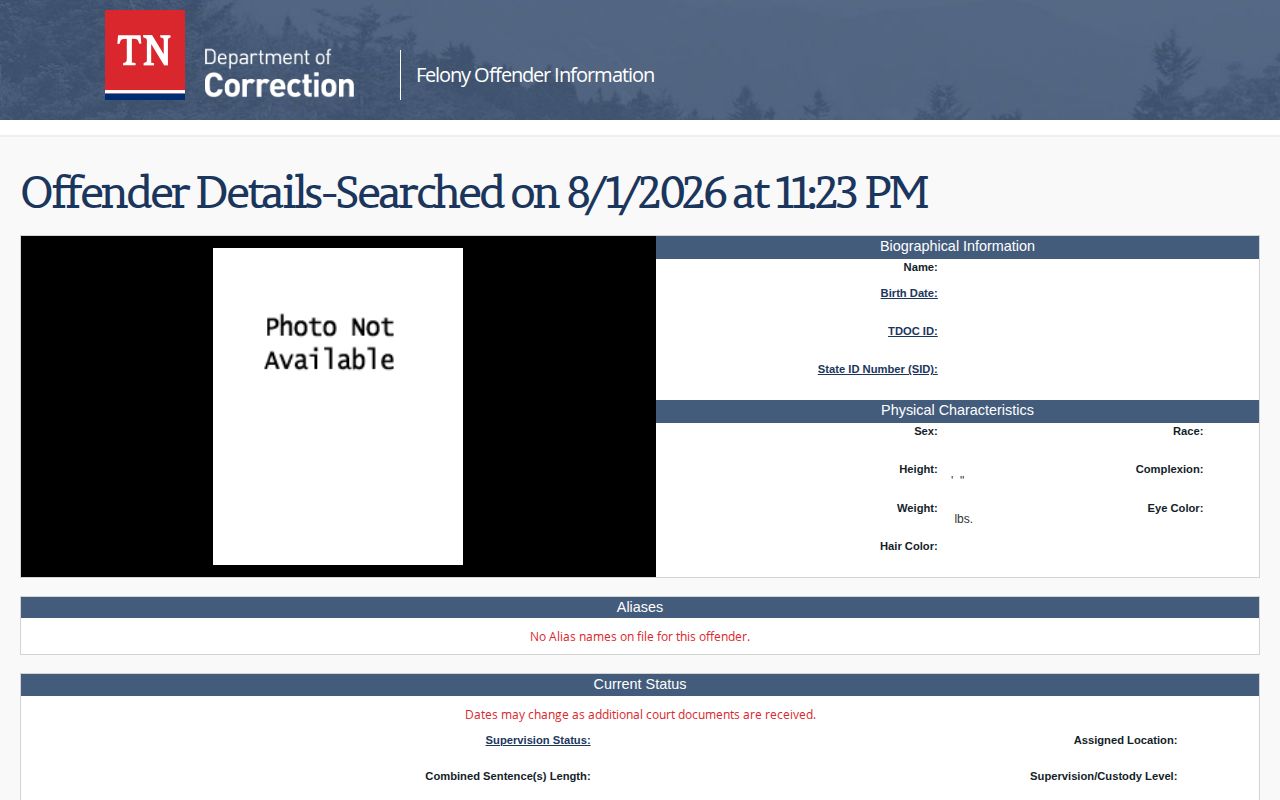
The grouped display is why Release Eligibility Date must not be copied without the current status, sentence end, active sentence, and parole information around it.
FOIL warns that dates can change as more court documents arrive. “No active Tennessee sentences on file” or inactive status can support the conclusion that FOIL shows no active state sentence, but neither label proves a specific Smith County community-release time unless a separate record supplies it.
Note: FOIL covers Tennessee felony records and should not be expected to list each short Smith County jail stay.
Smith County Eligibility Date Calculations
Tenn. Code Ann. § 40-35-501 governs many Tennessee felony release-eligibility rules. The calculation depends on the offense, offense date, offender range, judgment, consecutive or concurrent structure, and statutory exclusions. TDOC computes the state dates. Unofficial subtraction from the sentence length can miss a controlling rule.
The statute includes different ordinary eligibility percentages. Research identifies 20 or 30 percent treatment for especially mitigated offenders depending on the judgment, 30 percent for Range I standard offenders, 35 percent for Range II multiple offenders, 45 percent for Range III persistent offenders, and 60 percent for career offenders, subject to applicable credits and exclusions. Consecutive sentences require separate calculations and added periods of ineligibility.
There is no universal Tennessee rule requiring everyone to serve 85 percent. Historical 85-percent provisions apply only to specified offenses and offense-date ranges. The law also has offense-specific 100-percent service provisions for certain offenses committed in defined periods. Other provisions may let program credits affect parole eligibility while leaving sentence expiration unchanged. The correct approach is to match the exact conviction, date, range, and current statutory subsection.
TDOC calculates sentence expiration and Release Eligibility Date for felony offenders sentenced to TDOC and for qualifying felony offenders serving one year or more locally. A bond release, dismissal, or short county-only sentence can follow a different path and may have no FOIL eligibility field.
Smith County Earned-Time Credits
Tenn. Code Ann. § 41-21-236 allows qualifying offenders to earn up to 16 days per month. Up to eight days may be tied to good institutional behavior, and up to eight may be tied to satisfactory program performance. Credits are awarded and documented. They are not automatic.
Discipline, custody classification, segregation, and program participation can affect credit awards. Education and treatment credits have separate conditions and exclusions. Qualifying presentence confinement can receive up to eight days per month when the jail administrator documents it. The judgment, credit record, and TDOC calculation are needed before credits are used to estimate a Smith County inmate release date.
Local misdemeanor judgments may set a service percentage from 30 through 100 percent, subject to statutory limits on credit reduction. That is a county sentence question, not the same as FOIL’s felony Release Eligibility Date. Ask Smith County Jail for the time record and the clerk for the judgment rather than importing a state-prison percentage into a local case.
Why Smith County Release Dates Change
A published or computed date can move as the custodial agency receives records and applies sentence rules. A change is not always an error. The reason should be identified from the source record before the new date is repeated.
| Factor | Possible effect | Record to check |
|---|---|---|
| Awarded or lost credits | Can alter eligibility or expiration where the governing law permits | TDOC or jail credit calculation |
| New court documents | May correct the sentence, dates, or consecutive structure | Judgment and amended orders |
| Another sentence | Can add time or prevent physical release | Active sentence rows and court files |
| Detainer or hold | Can cause transfer instead of community release | Movement record and receiving agency |
| Parole decision | A grant, denial, deferral, revocation, or rescission changes the path | Board result and FOIL status |
| Release plan | An unapproved plan can delay a granted parole release | Board or TDOC confirmation |
Release Eligibility Date can also be deferred for institutional discipline under the governing rule. A grant of parole may remain conditional. Conversely, an updated judgment or awarded credit may change a calculation. Only the custodian can state the operational release date it is using.
Note: A Smith County custody-ending date may stay correct even when another agency’s later release date changes.
Smith County Parole Hearing Dates
The Tennessee Board of Parole says hearing schedules are updated weekly, normally Monday or Tuesday after a Monday holiday. It currently directs schedule requests to BD.HearingSchedules@tn.gov. Schedules may change. A listed hearing date confirms consideration only and does not establish an inmate release date.
The Board’s hearing information describes initial consideration, revocation, rescission, time-setting, and appeal proceedings. Hearing officers make recommendations, while Board members may adopt, modify, or reject them. A grant can still depend on pre-parole conditions and an approved release plan.
FOIL may show Parole Hearing Date and Parole Hearing Result for one person. Read the exact result rather than forcing it into a simple granted or denied label. When clarification is needed, contact the Board at 615-741-1150. Eligibility itself remains controlled by the sentence law, offense date, range, judgment, and exclusions.
Confirm Smith County Actual Release
For a Smith County Jail event, call the jail and then request the jail-register entry, release authorization, booking or movement log, and receiving-agency field. Pair that record with the court judgment or order. This confirms both the physical custody event and its legal basis. A person transferred to TDOC, another county, BOP, or ICE should be described as leaving Smith County custody for that agency, not simply as free.
For a future state event, a Smith County VINELink release alert can provide notice when the reporting feed changes. Confirm the wording with TDOC or the jail. VINE is not a permanent discharge archive, and its county and state feeds remain separate.
Federal dates require their own scope. A BOP locator result marked Released or Not in BOP Custody refers only to BOP physical custody. Federal supervision or a state hold may remain. An ICE result concerns ICE custody. Neither system should be searched unless a federal case, transfer record, detainer, register number, or A-number makes it relevant.
A fresh agency check is essential near the expected date. Sentence data may change after a new judgment, credit entry, disciplinary action, or hold reaches the custodian. Ask for the date label and its current basis. If staff describe an estimate, preserve that wording and do not convert it into a guaranteed release.
For historical proof, use the record owner. Smith County’s permanent jail register can preserve the local release date, the court file can preserve the sentence or disposition, and TDOC archives can preserve state material after a live page changes. Keep the agency label and access date with every result.