
Smith County Parole Versus Probation
Parole and probation both allow a person to live outside a jail or prison while following set rules, but they begin in different ways. The Tennessee Board of Parole may grant parole before a prison sentence expires. TDOC then provides community supervision. Probation is ordered by a court. It can be imposed instead of a jail term or after split confinement, which means a sentence divided between time in jail and time under supervision.
The distinction matters in Smith County because two systems serve the county. TDOC handles state felony parole and felony probation through District 31. Smith County Recovery Court and misdemeanor probation handle qualifying local cases. Leaving Smith County Jail does not end a sentence when the judgment requires either form of supervision.
| Point | Parole | Probation |
|---|---|---|
| Who authorizes it | Tennessee Board of Parole | The sentencing court |
| When it begins | Before the prison sentence expires, after a grant and release conditions | At sentencing or after release from split confinement |
| Smith County office | TDOC District 31 for state cases | District 31 for felony cases or the county office for local misdemeanor cases |
| Best public record | FOIL status and parole hearing result | FOIL for felony probation; judgment and local office for misdemeanor probation |
- Parole
- Conditional release from prison before the sentence expires.
- Probation
- Court-ordered supervision in the community, sometimes after a jail portion.
- Discharge
- The formal end of the supervision obligation.
- Absconder
- A person alleged to have stopped reporting or left supervision without permission.
Note: Physical release from Smith County custody can occur while a sentence continues under parole or probation supervision.
Verify Smith County Post-Release Supervision
Begin with the case type, not a guess about the supervising office. A short Smith County misdemeanor case may never appear in the statewide felony system. By contrast, a person released from state prison on parole should not be routed to the county misdemeanor office. The judgment identifies the sentence, and Tennessee FOIL supplies person-level status for current and former Tennessee felony offenders.
- Confirm the person’s full name and, when available, date of birth, TDOC ID, SID, or court case number.
- Search FOIL by name, TDOC ID, or SID. Compare the photo, identifiers, aliases, and descriptors when names repeat.
- Read Supervision Status and Assigned Location together. Probation or parole points to community supervision; inactive status needs context from sentence fields.
- Check active sentences, Sentence End Date, Release Eligibility Date, Parole Hearing Date, and Parole Hearing Result without treating one field as the whole record.
- Use the assigned office or the sentencing judgment to decide between TDOC District 31 and Smith County misdemeanor probation.
- Confirm current reporting responsibility with that office. Use the originating court when the judgment or supervision order is needed.
A released person will usually no longer appear on a current-only jail display. FOIL is broader, but only for a Tennessee felony relationship. The Smith County released-inmate search path explains how to retrieve the jail and court records that establish a county-only release.
FOIL’s official detail screen shows how status, location, sentence dates, and hearing fields sit together. The FOIL record view should be read as a set, not reduced to one date.
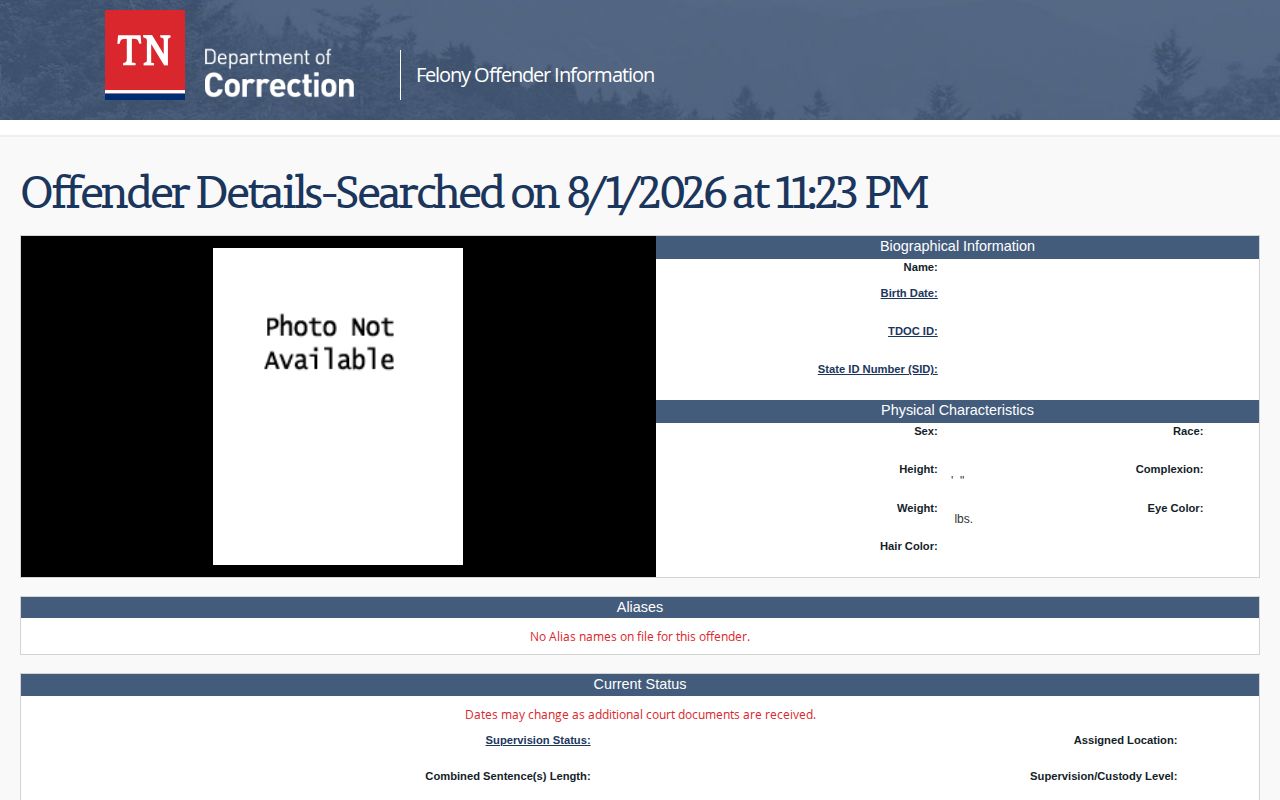
The grouped fields help separate a person in custody, a person supervised in the community, and a former offender whose state sentence is inactive.
Smith County Felony Supervision Office
Smith County state parolees and felony probationers are served by TDOC District 31 in Cookeville. The office is outside Smith County, yet it is the correct field office for these state cases. The TDOC field-office directory is the source to recheck before a visit because assignments and contact details can change.
851 South Willow Avenue, Suite 202
Cookeville, TN 38501
Phone: 931-526-7165
Fax: 931-528-3267
Ask whether District 31 is the assigned office and what public confirmation can be given. Staff may need a TDOC number or other identifying facts to separate people with similar names. A supervision address is not the same as an incarceration site. Assigned Location in FOIL may identify a field office when the person is living in the community.
The official directory displays Smith County within the expanded District 31 service area. Its county grouping is the key detail in the screenshot below.
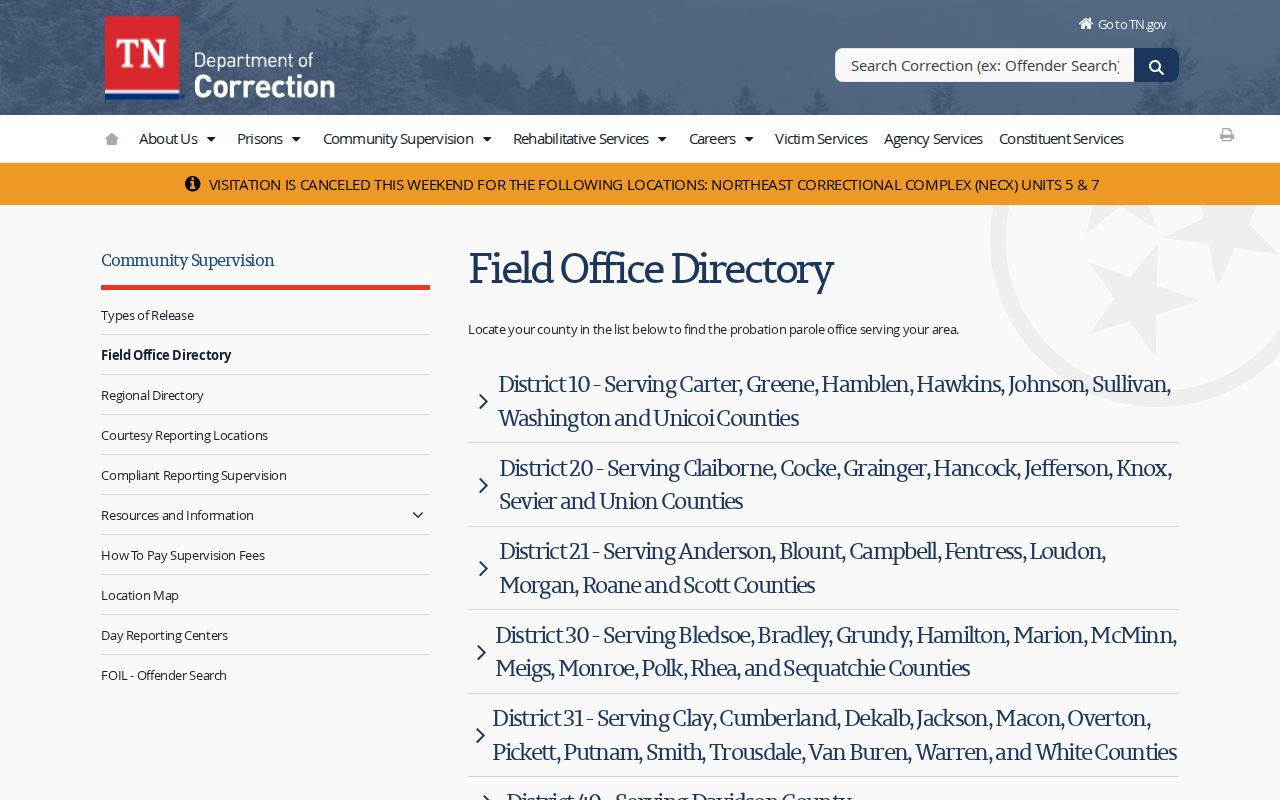
That district assignment prevents a state felony case from being sent to the separate county misdemeanor program at Justice Drive.
Note: A field-office assignment verifies supervision responsibility, not the exact time a person left jail or prison custody.
Smith County Misdemeanor Probation
Smith County operates Recovery Court and local misdemeanor probation at the Justice Drive complex in Carthage. This is the distinctive local route for a person whose judgment assigns county supervision. The county states that reporting may occur biweekly or monthly depending on the case. That schedule is case-specific, so a general office description should not be turned into a claim about one person’s required dates.
322 Justice Drive
Carthage, TN 37030
Phone: 615-588-1550
Fax: 615-735-8261
Monday through Friday, 8 a.m. to 4 p.m.
The county probation page publishes the office route and local reporting details. Use the court judgment to confirm that the person belongs there. A felony probation label in FOIL points instead to TDOC, even if the original arrest occurred in Smith County.
Which Smith County Office Applies?
The two-office split is easy to miss. Justice Drive brings the jail, courts, Recovery Court, and local probation close together. State felony supervision is still based in Cookeville. Sending a state parolee to the local misdemeanor desk can delay confirmation, while searching FOIL for a county-only misdemeanor case may return nothing even though a probation order exists.
Use a simple record test. If FOIL shows parole or felony probation and assigns a TDOC location, start with District 31. If a Smith County judgment places the person on local misdemeanor probation or in Recovery Court, use the Justice Drive office. When records conflict, ask the sentencing clerk for the current order and ask the named supervision office to confirm responsibility. The office that supervises the case can change after a transfer or Interstate Compact placement, so a dated confirmation is best.
Smith County Supervision Violations
Conditions are the rules attached to release or probation. The exact rules come from the Board, court, and supervision documents. A missed report or alleged violation may lead to a warrant, revocation process, or new custody, but the public record must show what actually occurred. Revocation means the authority formally cancels community supervision after the required process; an allegation alone is not a final result.
No reliable official Smith County absconder list was found. Therefore, a name missing from FOIL or a county page cannot be described as proof that no warrant exists. Ask the supervising office about public status, check the issuing court for filed orders, and use the custodial agency if the person has been taken into custody. VINE may send a custody-change notice, but it does not certify the basis for a supervision violation.
Parole hearing schedules also require care. A scheduled hearing means the Board plans to consider a matter. It does not show that parole was granted or that physical release occurred. FOIL’s Parole Hearing Result, a Board record, and a later supervision status provide stronger evidence.
Smith County State Release Paths
TDOC identifies more than ordinary parole and probation. Determinate release is a special probation route for qualifying felony sentences of at least one year and no more than two years. TDOC states that it requires at least 30 percent service and notice to the district attorney, sheriff, and warden, with a process for court objection. It should not be assumed from sentence length alone.
Mandatory reentry supervision is another distinct state mechanism for qualifying felony sentences. Eligibility and exclusions depend on the governing law, offense date, and sentence. Neither label is a synonym for bond release from Smith County Jail. The TDOC types-of-release page provides the official definitions and should be matched to the judgment and FOIL status.
A transfer from Smith County Jail to TDOC is also not community release. The county custody record may close while the person enters state custody. FOIL may then show an institution, and later it may show a field office after release to supervision. Read each status with its agency and date.
Note: Probation after split confinement should be checked promptly because TDOC states that reporting is due within 48 hours.
Smith County Supervision Discharge Records
Supervision ends through a formal discharge, sentence expiration, court action, or another documented change. Physical release from jail or prison may occur much earlier. FOIL can show inactive status or no active Tennessee sentence, but that display does not by itself prove the date and terms of a specific county release. For a state case, compare Supervision Status, active sentence rows, and Sentence End Date, then request TDOC records when formal proof is needed.
For local probation, the Smith County judgment and later court orders establish the term and any discharge or revocation. The Circuit Court Clerk can supply the actual record rather than an oral summary. A docket is useful for locating a case date, but it is only a schedule. Obtain the signed order or judgment for the legal result.
Tennessee public-record rules generally require a request to identify existing records with enough detail. An office need not answer open-ended questions or create a new report. Ask for the named discharge order, supervision order, judgment, or TDOC record for the identified person and case. Restricted, sealed, expunged, or otherwise confidential material may be withheld or redacted under applicable law.